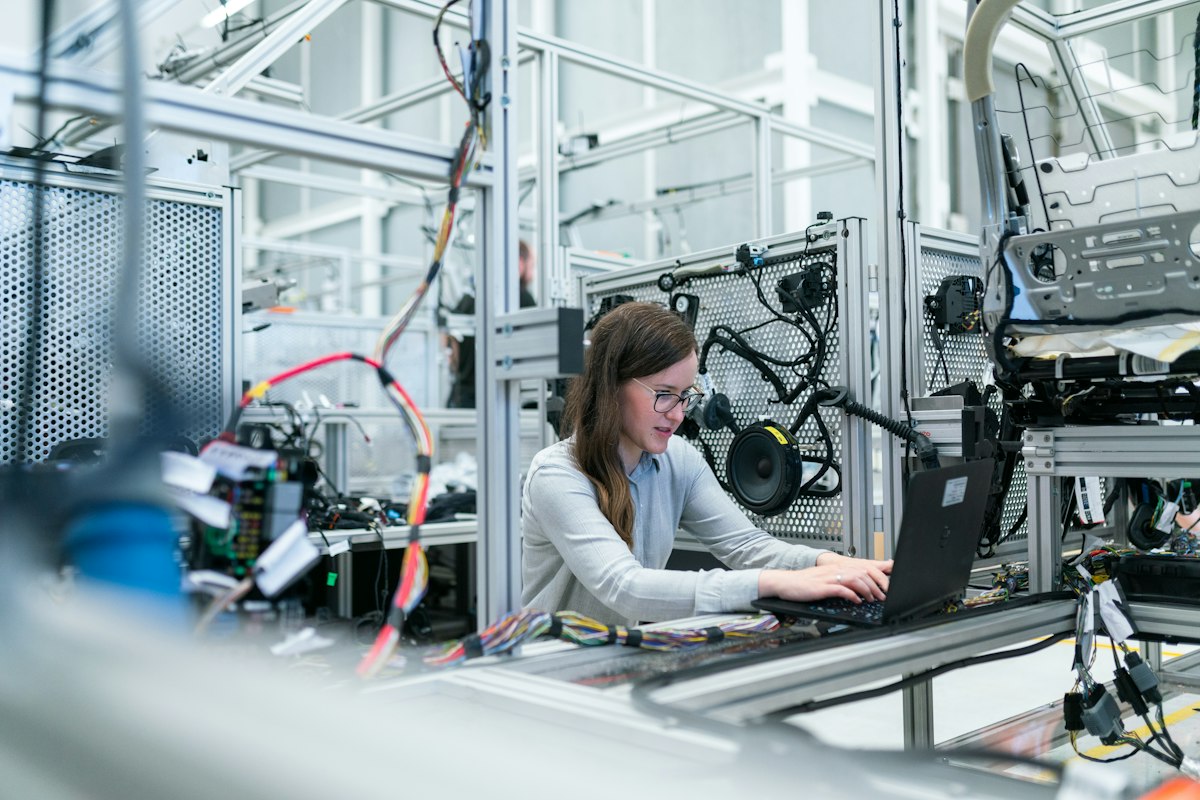
Manufacturing has always been about efficiency—producing more with less. AI takes this to new levels by predicting failures before they happen, optimizing production in real-time, and ensuring quality at speeds impossible for human inspection. The result is factories that are not just automated, but intelligent.
Predictive Maintenance
Unplanned equipment downtime costs manufacturers billions annually. Traditional maintenance follows schedules—replace parts after X hours of operation. This wastes money on premature replacements and fails to catch failures that occur early. Predictive maintenance uses AI to analyze sensor data—vibration, temperature, pressure, sound—and predict when equipment will fail.
Companies like Siemens and GE have deployed predictive maintenance systems that reduce unplanned downtime by 30-50%. The AI learns normal operating patterns and flags anomalies that precede failures. Maintenance happens exactly when needed, not before or after. This optimization alone can save millions in a single facility.
Manufacturing AI Applications:
- Predictive Maintenance: Failure prediction, condition monitoring, maintenance scheduling
- Quality Control: Visual inspection, defect detection, process monitoring
- Production Optimization: Scheduling, resource allocation, energy efficiency
- Supply Chain: Demand forecasting, inventory optimization, logistics
Computer Vision Quality Control
Visual inspection has been a manufacturing bottleneck for decades. Human inspectors can miss defects, get fatigued, and work at limited speeds. AI-powered computer vision systems inspect products at superhuman speeds with consistent accuracy. They catch defects invisible to human eyes—microscopic cracks, subtle color variations, dimensional deviations.
These systems learn from thousands of examples of good and defective products. They adapt to new product lines quickly and improve over time. Companies report 99%+ defect detection rates while inspecting products at speeds impossible for humans. The cost savings from reduced recalls and warranty claims are substantial.
Production Optimization
Manufacturing involves countless variables—machine settings, material properties, environmental conditions, operator actions. Optimizing these manually is impossible. AI systems continuously analyze production data to find optimal settings that maximize throughput while minimizing waste and energy consumption.
Reinforcement learning algorithms experiment with different production parameters, learning what works best. They optimize not just individual machines but entire production lines, balancing bottlenecks and resource allocation. The result is production that runs closer to theoretical maximums.
Supply Chain Intelligence
AI helps manufacturers navigate complex global supply chains. Demand forecasting models predict what customers will want months in advance, enabling better inventory planning. When disruptions occur—natural disasters, geopolitical events, supplier issues—AI helps identify alternatives and optimize logistics.
The smart factory of the future will be a self-optimizing system where AI manages everything from raw material ordering to final product delivery. Humans will focus on strategy, innovation, and handling exceptions. This vision is already partially realized in leading facilities, and the trajectory suggests full automation is achievable within a decade.
Key Takeaways
- • Predictive maintenance reduces downtime by 30-50%
- • Computer vision inspection achieves 99%+ accuracy at high speeds
- • AI optimizes production parameters in real-time
- • Supply chain AI improves forecasting and resilience
- • Smart factories represent the future of manufacturing